




How electricity blackouts, internet disruptions, destroyed schools and underground classrooms are reshaping learning in Ukraine, 2022–2026
Executive Summary
Four years after Russia’s full-scale invasion of Ukraine, the country’s education system continues to operate under extraordinary pressure. Millions of children have been displaced, thousands of educational institutions have been damaged, and repeated attacks on energy and telecommunications infrastructure have undermined the systems that make modern education possible.
Ukraine has responded through remote learning, digital education platforms, emergency shelters, underground schools and international partnerships. Yet the ability to continue teaching is not the same as the ability to provide uninterrupted, equitable and effective education.
The consequences extend beyond temporary school closures. Electricity outages disrupt internet connectivity, digital devices and heating. Air-raid alerts interrupt both classroom teaching and remote lessons. Displacement separates children from familiar schools, teachers and communities. Together, these factors create cumulative risks for educational attainment, psychological wellbeing and future opportunities.
The scale of disruption is visible in official statistics:
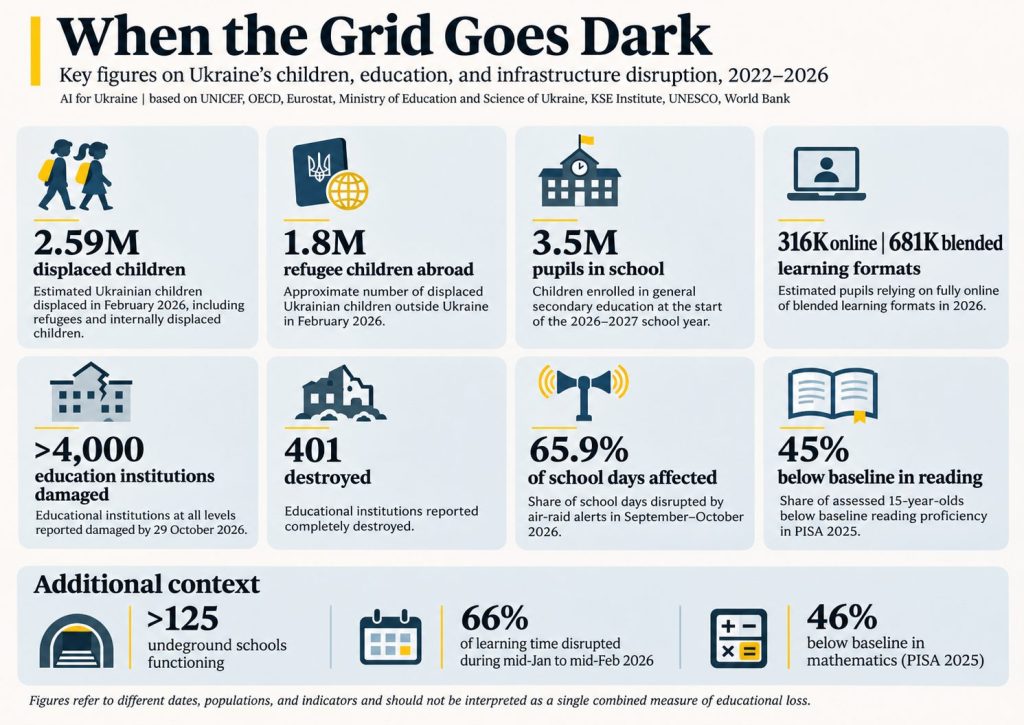
- Nearly 2.6 million Ukrainian children remained displaced in February 2026, including almost 1.8 million outside Ukraine.
- More than 3.5 million pupils began the 2026–2027 academic year in Ukraine’s general secondary education system.
- Approximately 316,000 pupils were learning fully online, while another 681,000 were in blended learning, according to UNICEF’s 2026 humanitarian planning data.
- More than 4,000 educational institutions at all levels had been damaged, and 401 destroyed, according to Ukraine’s Ministry of Education and Science as of 29 October 2026.
- Air-raid alerts affected 65.9% of school days in September–October 2026.
- 45% of assessed 15-year-olds did not reach baseline reading proficiency, while 46% fell below the baseline in mathematics in PISA 2025.
These figures describe different dimensions of the crisis. They should not be combined into a single measure of educational loss.
The central finding of this analysis is that educational resilience increasingly depends on the resilience of interconnected systems: electricity, telecommunications, physical infrastructure, safe learning spaces, devices, teaching capacity and family support.
Digital technology is indispensable to Ukraine’s education response, but technology alone cannot compensate for the absence of reliable infrastructure.
1. A Generation Displaced: The Scale of the Educational Challenge
Ukraine’s education crisis begins with the scale of population displacement.
According to UNICEF’s February 2026 assessment, approximately 2,589,900 Ukrainian children remained displaced:
| Displacement category | Children |
|---|---|
| Refugees outside Ukraine | Approximately 1,798,900 |
| Internally displaced within Ukraine | More than 791,000 |
| Total displaced | Approximately 2.59 million |
These are estimates of children remaining displaced, not the cumulative number who have crossed borders since February 2022.
The European Union represents a major destination for displaced families. On 30 September 2026, Eurostat recorded 4.37 million people who had fled Ukraine and held temporary protection in the EU. Minors accounted for 28%—approximately 1.22 million people.
The figures are not interchangeable: UNICEF’s estimate covers refugee children internationally, while Eurostat records a specific legal status within EU countries.
For displaced children, enrolment in a school does not necessarily guarantee educational continuity. Families must navigate different languages, curricula, assessment systems and technological requirements.
A UNICEF regional review published in 2026 estimated that approximately 78% of displaced Ukrainian children were enrolled in compulsory education in host countries by 2024. However, some children simultaneously followed Ukrainian online classes, creating an additional academic workload.
This raises an important question: how should educational participation be measured when a child may attend a local school, remain enrolled in a Ukrainian school and complete digital assignments across two national education systems?
Displacement has transformed Ukrainian education from a predominantly national system into a transnational network of schools, families, teachers and digital platforms.
2. How Many Children Are Still Learning in Ukraine?
Despite the war, Ukraine continues to operate one of Europe’s largest education systems.
According to the Ministry of Education and Science, more than 3.5 million pupils began the 2026–2027 academic year in 11,940 general secondary schools, supported by more than 366,000 teachers.
The Ministry reported the following distribution of schools at the beginning of the academic year:
| School operation mode | Number of institutions |
|---|---|
| In-person | More than 8,000 |
| Blended | More than 2,211 |
| Fully remote | 1,306 |
These figures describe schools, not individual pupils. Institutions may also change their operational mode depending on security conditions.
UNICEF’s 2026 humanitarian appeal provided separate student-level estimates: approximately 316,000 children learning fully online and 681,000 participating in blended learning.
Together, these groups account for close to one million pupils who depend substantially on digital learning arrangements. They should not, however, be interpreted as one million children learning exclusively online.
By 29 October 2026, the Ministry reported 12,210 operating general secondary education facilities, including branches, of which approximately 90% provided some in-person or blended learning.
The difference between the September and October institution counts reflects different reporting dates and coverage; it does not establish that hundreds of new schools were created within weeks.
University education is also affected
The challenge extends beyond school-age children.
At the beginning of the 2026–2027 academic year, Ukraine’s Ministry of Education reported more than one million students enrolled in higher education institutions, including nearly 300,000 new undergraduate and postgraduate entrants.
University students face disruptions to lectures, laboratories, research facilities, digital assessment systems and access to academic resources.
For students in scientific and technical disciplines, an internet connection alone cannot replace laboratories, specialist equipment or safe access to campus infrastructure.
A functioning higher education system therefore requires both digital continuity and physical infrastructure that supports practical learning and research.
3. The Infrastructure Chain: Why a Power Outage Can Become an Education Crisis
The impact of infrastructure damage is rarely confined to a single service.
A power outage may interrupt household electricity, but it can also affect telecommunications networks, school heating, water supply, transportation, digital equipment and access to public services.
For a child participating in remote education, several systems must function simultaneously:
- A charged and working learning device.
- A reliable electricity supply or adequate backup power.
- A functioning internet or mobile connection.
- An available teacher and accessible digital learning platform.
- A safe environment in which learning can take place.
Failure at any one point can interrupt the entire educational process.
The International Telecommunication Union’s 2025 Digital Development Country Profile documents damage to telecommunications infrastructure, including mobile network facilities and fibre-optic connections.
The ITU also identifies electricity interruptions as a major threat to network reliability. Backup power systems can mitigate shorter outages but do not guarantee uninterrupted service during prolonged disruptions.
In September 2026, ACLED documented attacks affecting data centres and telecommunications providers in Ukraine, with approximately 100,000 households in the Kyiv region experiencing disrupted internet access.
This example illustrates how attacks on digital infrastructure can affect entire communities rather than isolated buildings.
The winter of 2025–2026: Quantifying lost learning time
One of the strongest available indicators of infrastructure-related educational disruption comes from UNICEF’s humanitarian reporting.
An Education Cluster analysis estimated that power and heating outages disrupted 66% of learning time between mid-January and mid-February 2026.
This is a period-specific estimate, not an annual percentage of education lost across Ukraine.
In a rapid assessment of vulnerable families conducted in late January 2026, UNICEF found that only 54% of surveyed households had electricity when interviewed, while 60% reported receiving fewer than six hours of electricity per day.
The sample focused on particularly vulnerable families and should not be treated as representative of every Ukrainian household.
Nevertheless, the findings demonstrate why remote education becomes especially difficult when electricity, heating and telecommunications are unreliable simultaneously.
Education cannot be resilient if the underlying systems supporting it are repeatedly unavailable.
4. Air-Raid Alerts: Interrupting Education Even When Schools Remain Open
Electricity and connectivity are only part of the problem.
In November 2026, UNICEF released new evidence showing that intensifying attacks were disrupting school time across Ukraine.
During September and October 2026, air-raid alerts occurred on 65.9% of school days, compared with 37.4% during the same period in 2025.
By 20 October, pupils had experienced an average of 34 hours of alerts during scheduled learning time—equivalent to more than 13% of scheduled instructional hours.
In Dnipropetrovsk, Kirovohrad and Kharkiv regions, children experienced more than 60 hours of school-time alerts, equivalent to approximately one quarter of scheduled learning hours and affecting over 560,000 children.
Source: UNICEF, 3 November 2026.
Air-raid alerts do not automatically mean that all teaching stops. Some schools continue lessons in equipped shelters. However, moving between classrooms and shelters, changes to schedules and prolonged periods of uncertainty can reduce effective instructional time.
The difference between scheduled education and actual learning opportunity is therefore becoming increasingly important.
Counting the number of schools officially open provides only a partial picture of educational access.
5. Underground Schools: A New Model of Educational Infrastructure
One of Ukraine’s most distinctive educational responses has been the development of underground learning facilities.
In cities and regions exposed to frequent attacks, underground classrooms enable pupils and teachers to continue face-to-face education in protected environments.
These projects are more than emergency shelters. They are attempts to preserve educational and social interaction under conditions in which conventional school buildings cannot always be used safely.
How extensive is the underground-school network?
In October 2026, Ukraine’s Ministry of Education reported that more than 125 underground schools were functioning nationally.
A separate ministry announcement stated that 238 underground schools and radiation-protection shelters combinedwere operating in general secondary education institutions.
These two figures use different categories and must not be presented as the same measure.
For example, four underground educational facilities completed in Zaporizhzhia city and region in October 2026 provided approximately 1,700 additional places for protected face-to-face learning.
The Ministry also announced UAH 5 billion in state funding for school shelters in 2026, covering 113 facilities across 22 regions.
Sources: Ministry of Education — underground schools in Zaporizhzhia and underground schools and shelters in Sumy region.
Beyond physical protection
Underground schools represent a new form of resilient public infrastructure.
Their potential value includes restoring peer interaction, providing more predictable access to teachers, reducing dependence on household connectivity and giving families a safer alternative to exclusively remote education.
Yet their effectiveness should be assessed using more than construction counts.
Important evaluation indicators include actual attendance, instructional hours delivered, educational outcomes, accessibility for children with disabilities, operational reliability, and student and teacher wellbeing.
The construction of a protected classroom is an infrastructure achievement. Its contribution to learning recovery is a separate question requiring evidence.
6. The Digital Divide: Why Remote Learning Is Not Equally Accessible
Remote learning has helped Ukraine maintain educational continuity, but it has also exposed substantial inequalities.
Access to online education depends on the availability of devices, affordable internet, reliable electricity, digital skills and appropriate learning environments.
A 2026 study by the KSE Institute’s Centre for Research on Education in Emergencies examined distance education across 65 schools, surveying 3,248 respondents, including 2,166 students and 960 teachers.
The findings revealed significant differences in technological and institutional preparedness.
For example:
- 67% of surveyed frontline schools used a unified digital learning platform, compared with 49% of non-frontline schools.
- 58% of frontline schools had an approved distance-learning strategy, compared with 26% of other surveyed schools.
- Among surveyed pupils in non-frontline schools, 50% relied exclusively on smartphones for learning, compared with 18% in frontline schools.
- Regular training for remote teaching was reported by 37% of frontline schools and 6% of non-frontline schools.
The seemingly counterintuitive differences may reflect the greater experience of frontline schools with emergency distance learning. They do not imply that children in frontline communities have better overall access to education.
Because the study covered a selected sample of 65 schools, these percentages should not be treated as national averages.
Source: KSE Institute research, published by the Ministry of Education, November 2026.
The problem of learning by smartphone
A smartphone can provide access to communication, videos and basic assignments. However, it is not an equivalent replacement for a laptop or desktop computer.
Writing longer assignments, using educational software, working with complex documents and developing advanced digital skills can be more difficult on a small screen.
This creates a distinction between having internet access and having adequate digital learning conditions.
Meaningful digital inclusion requires reliable connectivity, appropriate devices, accessible content and sustained teaching support.
7. Measuring the Educational Impact: What PISA and National Examinations Actually Show
Ukraine’s educational losses are difficult to measure because of the interaction of multiple disruptions.
These include the COVID-19 pandemic, Russia’s full-scale invasion, school destruction, displacement, air-raid alerts, electricity outages, changes in teaching formats and psychological stress.
The available evidence demonstrates serious educational challenges, but it does not establish that internet outages alone caused observed changes in learning outcomes.
PISA 2025: Resilience without recovery
The OECD’s PISA 2025 assessment included 8,962 students across 17 Ukrainian regions.
For security reasons, several eastern and southern regions were excluded. The results therefore cannot be treated as representing all Ukrainian territories.
Ukraine’s average scores were:
| Subject | PISA 2022 | PISA 2025 |
|---|---|---|
| Reading | 427 | 418 |
| Mathematics | 440 | 431 |
| Science | 449 | 448 |
Although the reported scores were lower in reading and mathematics, these differences were not statistically significant.
Ukraine’s Ministry of Education therefore characterises the results as evidence of resilience, but not yet recovery.
The more concerning finding is the proportion of students below baseline proficiency in 2025:
| Competency | Below baseline |
|---|---|
| Reading | 45% |
| Mathematics | 46% |
| Science | 35% |
Moreover, 29.3% of students performed below baseline in all three subjects.
These findings indicate that substantial numbers of assessed Ukrainian adolescents face difficulties with foundational competencies needed for further education and everyday problem-solving.
Comparison with 2018 requires caution because geographical coverage and testing conditions changed.
Sources: OECD PISA 2025 — Ukraine country note and Ukraine’s Ministry of Education analysis.
What about Ukraine’s National Multi-Subject Test?
The National Multi-Subject Test (NMT), used for university admission, provides another important but different perspective.
According to the Ukrainian Center for Educational Quality Assessment, the proportion of main-session participants achieving the required thresholds in all four subjects was:
| Year | Passed all four thresholds |
|---|---|
| 2024 | 85.60% |
| 2025 | 86.47% |
| 2026 | 85.09% |
These results do not show a consistent year-by-year decline. They also measure admission-related achievement among test participants rather than the full school-age population.
Annual changes in participants, examinations and threshold rules limit direct comparisons.
It would therefore be inaccurate to claim that NMT statistics prove a continuous decline caused by electricity or internet blackouts.
Source: Ukrainian Center for Educational Quality Assessment — NMT 2026 results.
The broader evidence supports a more careful conclusion: Ukraine faces persistent learning challenges while education continues under exceptional disruption, but the contribution of specific infrastructure failures requires further evaluation.
8. Beyond Academic Performance: Children’s Development and Wellbeing
Education is more than academic instruction.
Schools provide daily routines, social interaction, emotional support, access to teachers and opportunities to identify children who need additional assistance.
For younger children, disrupted access to preschool education can affect early learning, socialisation and readiness for primary school.
UNICEF’s 2026 Multiple Indicator Cluster Survey findings showed that only 48% of children aged 36–59 months attended early childhood education. Regional disparities were substantial: attendance was approximately 69% in western regions but only 19% in eastern regions.
For adolescents, disruptions may affect motivation, social connections, future educational choices and transitions to employment.
Repeated displacement and infrastructure failures can also increase pressure on caregivers and teachers, making the quality of the home learning environment more difficult to sustain.
Digital disconnection may intensify isolation when young people cannot contact classmates, access educational resources or communicate with support services.
However, psychological, social and educational outcomes should be studied separately rather than assuming that every disruption produces the same effect for every child.
The needs of children with disabilities, displaced children, rural households and families living near the front line require particular attention.
9. How International Institutions Are Supporting Ukraine’s Education System
International assistance has played a central role in maintaining education, rebuilding infrastructure and supporting children affected by the war.
The response spans humanitarian programmes, education-system financing, digital infrastructure, teacher training and child protection.
UNICEF: Learning recovery, digital access and child protection
UNICEF works with Ukrainian authorities and partners to support safe learning environments, catch-up education, digital resources, school shelters and psychosocial services.
Its January–September 2026 humanitarian report recorded 124,928 students participating in UNICEF-supported catch-up classes.
During the same reporting period, UNICEF and partners reached 375,137 people with mental health and psychosocial support, including 219,023 children.
UNICEF has also supported heating systems, backup energy solutions and access to essential services, recognising that education depends on functioning infrastructure and family wellbeing.
Source: UNICEF Ukraine Humanitarian Situation Report No. 62, September 2026.
UNESCO: Digital learning and system resilience
UNESCO’s education response combines emergency support with longer-term institutional recovery.
Its priorities include providing hardware, software and educational materials; supporting teacher professional development; rehabilitating educational infrastructure; and improving evidence-based education planning.
The organisation also works on challenges involving displaced learners, digital access and the governance of education systems across borders.
Source: UNESCO — Ensuring teaching and learning continues in Ukraine.
World Bank: Financing education recovery
The World Bank’s LEARN programme supports education access and resilience through results-based financing.
At the Ukraine Recovery Conference in 2026, the World Bank announced an additional US$286 million for the programme.
Before that announcement, Ukraine had already mobilised US$451 million through LEARN.
Reported achievements included training more than 240,000 teachers, providing textbooks to over 779,000 students, supporting free school transportation for more than 18,000 children, and improving safe-shelter access for approximately 12,000 students and educators.
These are programme-reported outputs, not independently measured learning gains.
Source: Ministry of Education — World Bank LEARN programme, 2026.
European Union: Education infrastructure and refugee inclusion
The European Union supports Ukraine through reconstruction financing, education-related programmes and assistance to displaced Ukrainian families in member states.
Ukraine’s school-shelter infrastructure programme has benefited from European financial support linked to the Ukraine Facility, alongside national resources and international development financing.
EU member states also provide education to displaced Ukrainian children, although enrolment, language integration and curriculum coordination remain important challenges.
Education Cannot Wait and research partners
Education Cannot Wait, the UN global fund for education in emergencies and protracted crises, has supported efforts to maintain learning during the war.
Research conducted through the KSE Institute under an Education Cannot Wait-funded programme provides evidence about distance learning, school readiness and digital inequality.
Such research is important because effective reconstruction requires more than financing infrastructure. It requires understanding which interventions improve actual educational access and learning outcomes.
10. From Emergency Digital Education to Resilient Learning Systems
Ukraine’s experience reveals several important lessons for education systems operating under prolonged crisis.
First, educational access is an infrastructure issue. Learning continuity depends on electricity, telecommunications, safe physical spaces and services that allow families and teachers to participate.
Second, digital access should be measured by quality, not simply availability. An unstable mobile connection and shared smartphone do not provide the same learning opportunities as reliable broadband and a dedicated computer.
Third, hybrid education requires deliberate institutional design. Schools need trained teachers, coherent digital platforms, accessible learning materials, realistic schedules and reliable support mechanisms.
Fourth, protected physical infrastructure remains essential. Underground schools and equipped shelters can complement remote learning, but their success should be evaluated through attendance, learning outcomes and student wellbeing—not construction statistics alone.
Fifth, educational recovery needs stronger causal evidence. Available data quantify disruption and show persistent learning challenges, but more research is necessary to understand precisely how electricity interruptions, telecommunications failures and changes in learning format affect children over time.
11. A Research Agenda for Child-Centred Digital Resilience
Ukraine offers an opportunity to develop evidence that could inform education in emergencies worldwide.
Several areas deserve priority.
Connectivity and learning outcomes. Researchers could examine whether the duration and frequency of internet interruptions are associated with changes in attendance, assignment completion and educational performance.
Infrastructure disruption and inequality. Studies should assess whether children in rural areas, displaced households or lower-income families experience greater disruption because of limited backup power, devices or alternative connectivity.
Underground schools and educational continuity. Comparative evaluations could examine how access to protected classrooms influences instructional time, peer interaction, attendance and learning recovery.
Digital platforms and teacher capacity. Research could assess which combinations of teacher training, offline content, accessible devices and digital learning systems are most effective under unstable conditions.
Children’s wellbeing and participation. Evaluations should include age-appropriate, safeguarding-sensitive ways of understanding children’s experiences, rather than relying exclusively on administrative or technical indicators.
To make these findings actionable, research should distinguish direct infrastructure failures from other wartime factors, include appropriate comparison groups where feasible, and document uncertainty.
Privacy, consent, child safeguarding and secure data management must guide any collection of information involving children.
The goal should be to identify not only what has been lost, but which interventions can most effectively protect learning and development.
Conclusion: Digital Resilience Is Educational Resilience
Ukraine’s education system has demonstrated remarkable adaptability under conditions of prolonged war.
Millions of pupils continue learning. Teachers have developed remote and hybrid approaches. Communities have established underground schools. International institutions have helped maintain services, rebuild facilities and provide educational support.
Yet the available evidence reveals substantial challenges: persistent weaknesses in foundational skills, extensive displacement, recurring interruptions to instructional time and inequalities in digital access.
The central lesson extends beyond Ukraine.
The right to education increasingly depends on the resilience of interconnected physical and digital infrastructure.
When electricity fails, telecommunications may fail with it. When connectivity is lost, remote education becomes inaccessible. When conventional school buildings are unsafe, protected alternatives become essential. When families are displaced, digital education can help preserve learning—but only if the necessary systems remain available.
For governments, humanitarian organisations and technology developers, the priority is therefore not simply to expand digital education.
It is to build education systems capable of continuing to function when the infrastructure supporting them is disrupted.
Ukraine’s experience can contribute valuable lessons to this global challenge, provided that practical innovation is accompanied by rigorous evidence, child-centred evaluation and sustained international cooperation.
Methodology and Limitations
This article is a desk-based analytical review of publicly available institutional reports, government statistics and research publications available as of 15 November 2026.
It does not present original survey findings, interviews, experimental results or a systematic causal evaluation.
Several limitations should be considered:
- Student enrolment figures and school-operation figures use different units and reference dates.
- International displacement estimates cover different populations and geographical areas.
- Some humanitarian estimates represent selected populations or emergency periods rather than national annual averages.
- PISA 2025 covered 17 Ukrainian regions and excluded several conflict-affected territories.
- NMT results reflect a selective examination population and are not a direct measure of overall educational attainment.
- Observed learning challenges cannot be attributed exclusively to internet outages or electricity interruptions without further research.
The analysis distinguishes reported figures from interpretation and identifies research needs where existing evidence is insufficient.
References
- UNICEF — Children Displaced by War in Ukraine, February 2026
- Eurostat — Temporary Protection, September 2026
- Ministry of Education and Science of Ukraine — Start of the 2026–2027 Academic Year
- Ministry of Education — Education Sector Working Group, November 2026
- UNICEF — Ukraine and Refugee Response Appeal, 2026
- UNICEF — School-Time Air-Raid Alerts, November 2026
- OECD — PISA 2025 Country Note: Ukrainian Regions
- Ministry of Education — Ukraine PISA 2025 Analysis
- Ukrainian Center for Educational Quality Assessment — NMT 2026
- KSE Institute — Distance Learning Research, 2026
- ITU — Ukraine Digital Development Country Profile, 2025
- UNICEF — Humanitarian Situation Report, January–September 2026
- UNESCO — Education in Emergencies: Ukraine
- World Bank / Ministry of Education — LEARN Programme, 2026
- UNICEF — Inclusion, Learning and Resilience, 2026
- ACLED — Ukraine’s Internet Infrastructure, 2026